


Summer 2026: France’s tourism map expands
The Alliance France Tourisme outlines the initial trends for summer 2026 in hotels, tourist residences, and vacation villages. The season is taking shape around three key factors: record-breaking heat is shifting demand toward the English Channel coast and the mountains; purchasing power considerations are causing some travelers to postpone their trips to June and September; and the high-end market, driven by international guests, continues to drive up prices. After an excellent start to the season and a wait-and-see first half of August, reservations point to a strong finish to the season and, overall, a positive outcome for the June-September period this summer.
Explore the region-by-region analysis on the interactive map for summer 2026.
An exceptional start to the season, driven by Paris and special events
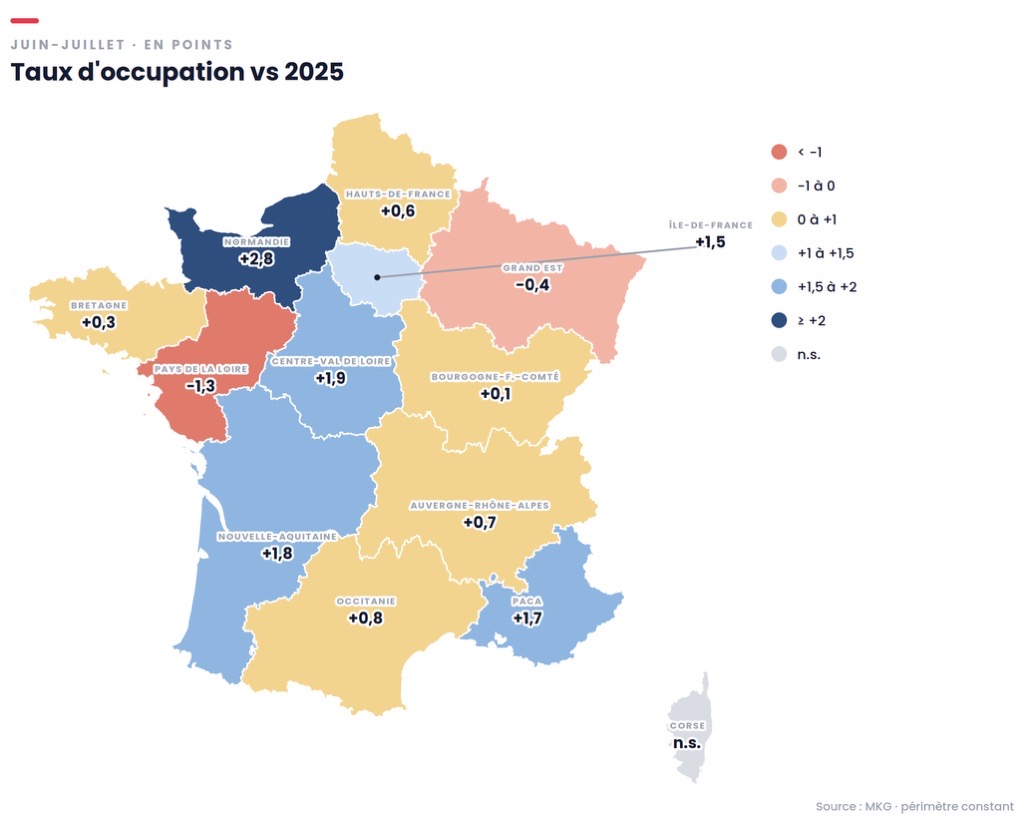
In June, nearly eight out of ten rooms were occupied in the French hotel industry (79.1%, up 1.3 percentage points from 2025), with revenue per available room (RevPAR) up 3.7%. July confirmed this trend (+0.9 percentage points in occupancy, +3.3% in RevPAR), even though July 2026, with an average temperature of 24.9°C, was the hottest month ever recorded in France.
Paris reaffirms its role as a driving force: nine out of ten rooms were occupied in June (90%), then 84.6% in July (+1.5 percentage points), bolstered by the Esports World Cup: Parisian hotels exceeded an 85% occupancy rate as early as the week the competition began, and the 15th arrondissement, which is hosting the event, saw a 4.3-point increase in occupancy and a rise of more than 10% in RevPAR in July.
A wait-and-see first half of August, amid geopolitical tensions, prices, and wildfires
The peak of the season saw a lull: from August 1 to 17, nearly three out of four rooms remained occupied (72.5%, down 0.7 percentage points from 2025), with RevPAR down 1.5%. The Gironde wildfire (approximately 42,000 hectares), which broke out on July 22 and was brought under control in early August, weighed most heavily on August stays due to cancellations: after a relatively unaffected July, the department saw its occupancy rate drop by 10 percentage points, while neighboring regions remained stable.
The traditional surge in last-minute bookings did not fully materialize, due to both the renewed tensions surrounding Iran since early July—which has made Gulf customers more hesitant to book—and historically high peak-season prices. This trend is evident nationwide, across all price ranges and regions; levels remain high in absolute terms, and some of the demand is shifting to late August and September.
Brittany, the Northern Alps, the French Riviera: the other summer hotspots
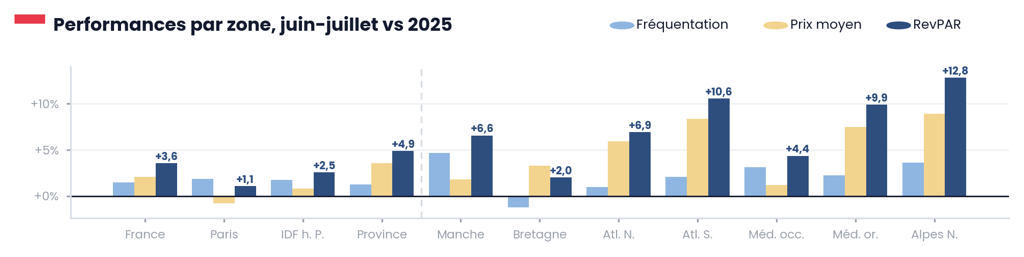
One of the key takeaways from the season is the expansion of France’s tourism map. Brittany is establishing itself as the premier summer destination: a 1.6-point increase in occupancy in August, RevPAR up 6.1% compared to 2025 and up 19% compared to 2024—a trend that extends beyond its coastline, which was more than 90% occupied at the height of summer. The Northern Alps are cementing their status as a two-season destination (RevPAR up 22% compared to 2025 in June).
The French Riviera remains a safe bet and the international showcase for France as a destination: in June, the eastern Mediterranean region posted a 12% increase in RevPAR compared to 2025 and a 30% increase compared to 2024, with occupancy rates exceeding 90% in the height of summer. Across the country as a whole, the upscale and luxury segments continue to drive growth (+4.4% RevPAR in June, +5.1% in July), without overshadowing the other segments, all of which are showing growth.
The English Channel coastline: the biggest increase of the summer
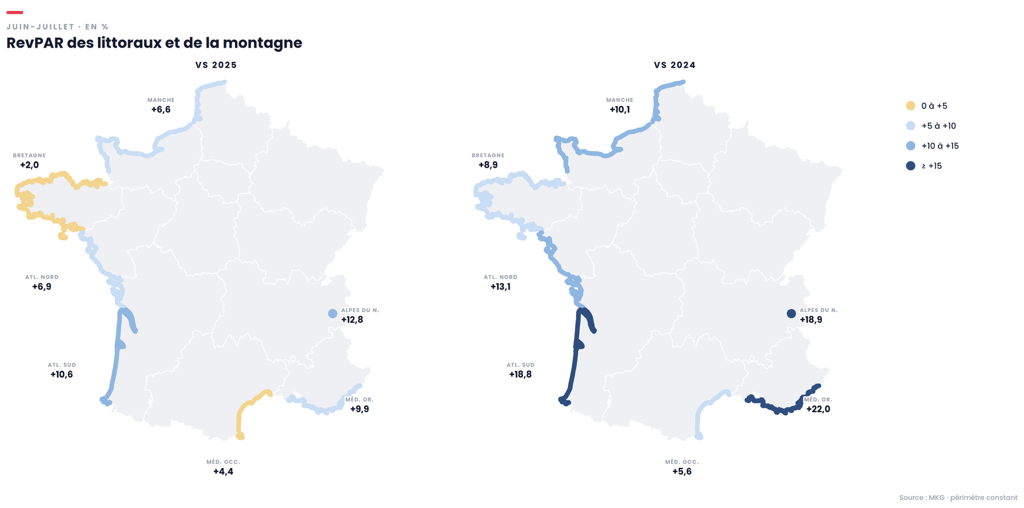
In a July marked by record-breaking heat, the English Channel coastline—from Le Havre to the Opal Coast—posted the strongest growth of any French coastline: a 4.5-point increase in occupancy year-over-year and nearly 10 points over two years. The increase accelerated starting in mid-July, particularly benefiting accessible and temperate destinations, and continued into August with occupancy rates exceeding 90%; it also boosted the inland areas, with Normandy as a whole gaining 2.6 points over the month. This timeline suggests a shift in part of the demand, driven by the combined effects of weather conditions, budget constraints, and a preference for nearby destinations. This trend is accompanied by a localized shift toward higher-end accommodations: Le Touquet increased its revenue per room by about a quarter year-over-year, while Deauville, Cabourg, Trouville-sur-Mer, and Ouistreham performed particularly well, with revenue per room up by more than 10% compared to July 2025.
Bookings that point to a strong end to the season
Reservations, which are ahead of last year’s figures for the same date, confirm that demand has shifted to the shoulder seasons, driven by customers with flexible schedules who travel in June or September to regain purchasing power. The second half of August is outperforming last year (+2 to +5 percentage points in occupancy rates, depending on the day); September is on par with 2025 or slightly above it, and the lead stands at 2 to 6 points for the last week of the month, even before the bulk of reservations are made. Despite the lull in the first half of August, the June–September season is thus heading toward a positive result, on par with the two excellent summers that preceded it.
Southern Europe is solidifying its status as a safe haven
Against a backdrop of geopolitical instability, international travelers are favoring Europe, with its southern flank benefiting the most. Spain exceeded an 82% occupancy rate in both June and July and began August with a sharp increase (+3.2 percentage points), confirming that the competitiveness gap between the two European leaders is widening each year; Germany is returning to growth (+7.2% RevPAR in June); Italy is treading water. France remains, along with Spain, one of the two main drivers of European tourism.
In conclusion, the summer of 2026 confirms two underlying trends: the spread of tourist visits across the shoulder seasons and the expansion of the range of destinations. France has never had so many drivers of tourism at the same time. The Alliance France Tourisme calls on industry stakeholders and public authorities to support this dual trend.
Highlights of Summer 2026
- Metz is awaiting the pope. Leo XIV’s visit on September 28 is already filling up the hotels: more than eight out of ten rooms have been reserved for the night of his arrival, six weeks before the event.
- The Esports World Cup is coming to Paris. Relocated from Riyadh, the competition will bring together more than 2,000 players from 100 countries at Porte de Versailles from July 6 to August 23. The impact is significant on a local scale: the 15th arrondissement, which is hosting the event, saw a 4.3-point increase in occupancy and a rise of more than 10% in RevPAR in July.
- The Monaco Grand Prix is moving to a different month. Now held on June 7—rather than at the end of May—it has shifted its peak hotel season to June: between Menton and Monaco, prices have risen by nearly two-thirds year-over-year, with occupancy remaining stable.
- Dunkirk is fully booked. More than nine out of ten rooms were occupied from August 1 through 17, an increase of more than 8 percentage points from a year ago: the northern coast is establishing itself as a summer destination.
www.alliance-france-tourisme.fr · Twitter : @AllianceFrT


