


Travelers and Artificial Intelligence: Key Figures for 2026
How do travelers behave, and what are their expectations when they use artificial intelligence? Initial studies provide valuable insights.
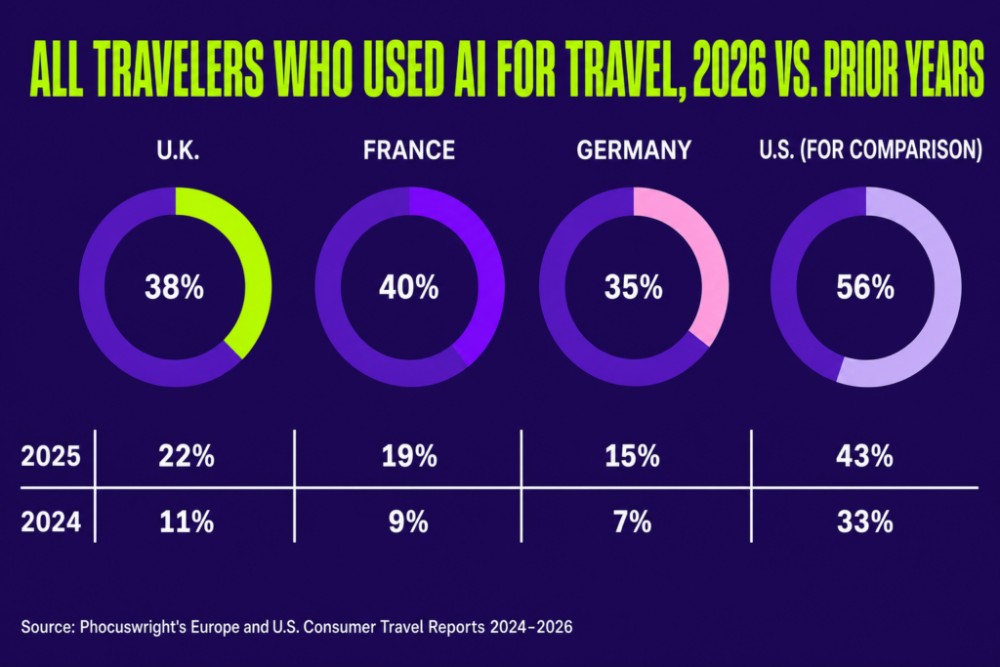
Travelers are quickly embracing artificial intelligence (AI). In France, 40% of travelers used it in 2026 to plan their trips, compared to 19% in 2025 and just 9% in 2024. The launch of ChatGPT in November 2022 marked a turning point in how people search for information. Consumers are now taking a more conversational approach.
As shown in the chart below, French travelers use AI slightly more than Germans and Britons, but less than Americans.
These data come from surveys conducted in February in the United States and in April in Europe, compiled in the study “The Rise of AI: The Fastest-Moving Behavioral Change in the Travel Industry in the Last Decade.”
A Trust Issue
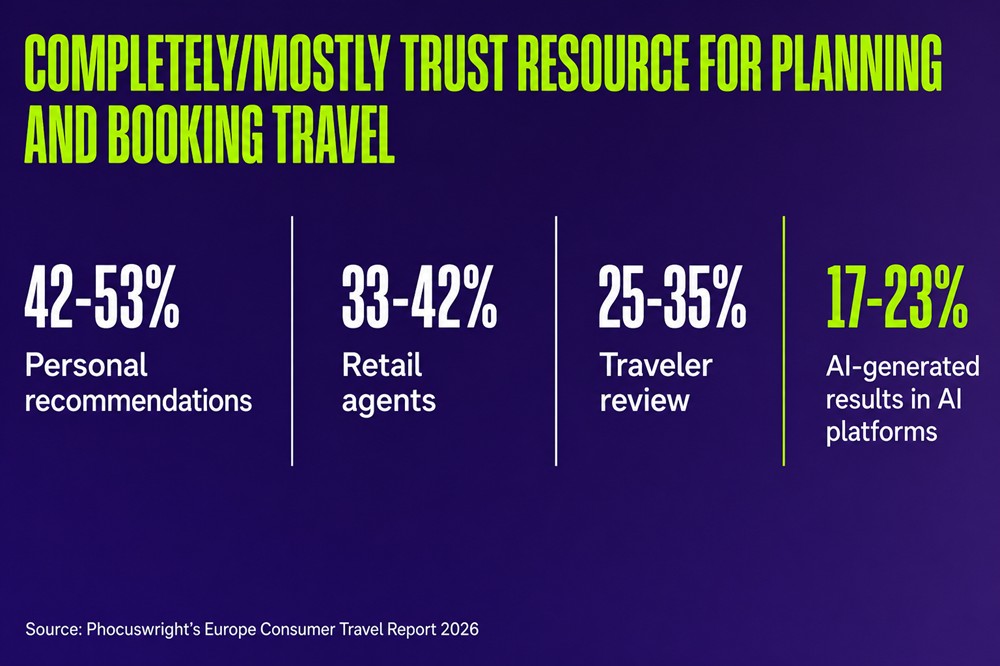
However, European travelers are skeptical about the accuracy of the information provided by ChatGPT, Gemini, and other AI models like Claude.
First and foremost, they rely entirely or primarily on recommendations from friends and family (42% to 53%). Next, in second place, are travel agents (33% to 42%), followed by traveler reviews (25%–35%). AI-generated results come in only fourth place (17%–23%). Large language models are just one step among many in the process of research and inspiration.
Another study, this time by Evaneos, also highlights this lack of trust. The travel platform commissioned an online survey from the YouGov research firm. A total of 1,689 people were surveyed between March 17 and 25, 2026. The results show that 74% of French people feel the need to verify the accuracy of results generated by AI. And 40% of those who plan to use AI for travel want a human review before making any reservations. The travel expert retains their place in the value chain.
Another key finding from the Evaneos study: families are the biggest users of AI. Nearly 4 out of 10 families with young children “are turning to AI-based tools to simplify logistics that are often more complex,” the company notes. It’s all about saving time.
In the United States, new expectations
A Phocuswright survey, conducted exclusively among U.S. travelers, examines expectations regarding artificial intelligence.
A better understanding of the traveler’s immediate context ranks far ahead of other AI improvements as the most desired (with 39% of responses). This is followed by more accurate information (29%), a simplified booking process (28%), and a single AI assistant for the entire trip (27%).
In other words, travelers want, above all, AI that is relevant and makes things easier—not AI that is more sophisticated.


